Gold IRA markups: the dealer spread over spot is the biggest number in your account.
Gold IRA markups are the gap between the spot price of the metal and the two prices a dealer actually gives you: the one you buy at, which sits above spot, and the one you eventually sell at, which sits below it. Add those gaps together and you get the round-trip cost of owning the metal, a figure that no provider we track prints anywhere, and one that on a five-figure order is worth more than a decade of the annual schedule you were comparing instead.
Advertising disclosure: Gold IRA Consulting is reader-supported. We may earn a commission when you open an account through some links on this page (marked sponsored). This never influences our editorial scores, which are based on independent research.
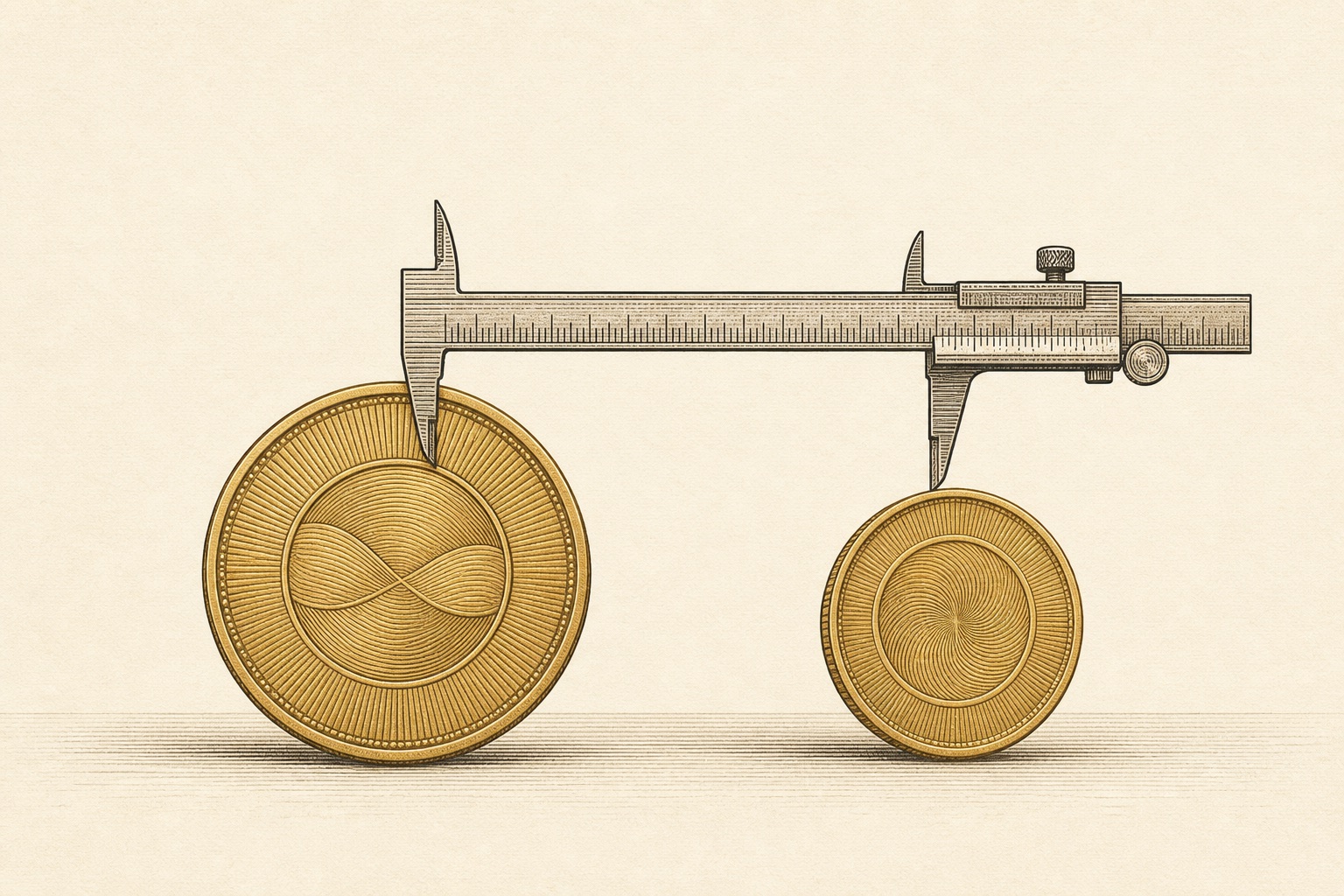
Two numbers decide this, and neither one appears on a fee schedule
Ask for the percentage above spot you are paying on each item, and the percentage below spot the dealer will pay to take those same items back today. Added together they are your round trip. On plain one-ounce bullion a defensible expectation is somewhere near 6 to 12 percent all in, which on a $50,000 purchase is $3,000 to $6,000 gone before the metal has moved a cent. Set that against the standing bill: American Hartford Gold publishes roughly $180 a year all-in, and Birch Gold Group publishes about $235 recurring, both verified Jun 2026.
- →The premium is charged once and immediately, so it cannot be waived away by a promotion the way a first-year fee can.
- →It is not published by anyone. We checked every provider we rank and record that gap rather than inventing a number.
- →Product class moves it more than provider choice does. The federal band for numismatic pieces starts at 40 percent above spot.
- →You can derive it yourself from any quote in about ninety seconds. The method is in the third section below.
Two prices, one round trip, and only one of them ever gets discussed
Spot is the reference, not the price. The Commodity Futures Trading Commission defines it in its buyer advisory as the cash price for immediate delivery of physical metal, quoted in dollars per troy ounce, and says it should be easy to obtain from any financial news or quote provider. Nobody sells you metal at that number. A dealer has to source coins, insure them, ship them to a depository and make a margin, so the offer you receive sits above the reference. That gap is the buy premium.
The half that gets ignored is the other end. When you eventually sell, the same dealer bids beneath the reference, and the distance between the ask you paid and the bid you receive is the round trip. Thinking in round trips changes the decision, because it converts a vague sense that metals are expensive to trade into a break-even figure. A 7 percent round trip means gold must rise 7 percent before your position is level in nominal terms, and that hurdle exists whether the metal goes up, down or nowhere.
Two things follow. First, a headline annual fee tells you almost nothing about what an account costs, which is why we treat the published schedule as the entry ticket rather than the answer; the full stack of setup, custodian, storage and wire lines is broken out on our gold IRA fees page and you can model it at any balance with the fee calculator. Second, the round trip is the one cost you can still change on the day you fund, because it is a function of what you buy and what you agree to pay, not of a schedule someone else set years ago.
Where gold IRA markups land by product class
Every band below is labelled with where it came from, because most of the ranges circulating in this niche have no attribution at all. The two percentages we treat as authoritative are the CFTC's, published in its retirement-savings advisory. Everything marked as ours is an estimate drawn from quotes our researchers collected, and we say so rather than dressing it up.
| PRODUCT CLASS | BUY PREMIUM OVER SPOT | WHERE THE BAND COMES FROM | LIKELY POSITION WHEN YOU SELL | IMPLIED ROUND TRIP |
|---|---|---|---|---|
| One-ounce sovereign bullion coins | 5% to 10% | CFTC customer advisory, stated for bullion generally | At or a little under spot on the most liquid coins | Roughly 6% to 12% |
| Approved bars, one ounce and larger | Usually the tightest class available inside an IRA | OUR ESTIMATE, NOT PUBLISHED | Priced on weight and assay, so the bid tracks spot closely | The lowest of any eligible product |
| Fractional coins, tenth and quarter ounce | Materially wider per ounce than the one-ounce version of the identical coin | OUR ESTIMATE, NOT PUBLISHED | Bid also computed per ounce, so the wider entry is not recovered | Wider at both ends |
| Proof and semi-numismatic pieces | 40% to 200% above spot | CFTC customer advisory, stated for numismatic coins | Repurchased on metal content, not on the story attached | The premium is largely unrecoverable |
| The documented enforcement extreme | 51% to over 70% average, on silver coins | CFTC enforcement action against Safeguard Metals, filed Feb 2022 | Nearly every customer took an immediate loss, per the agency | A ceiling, not a market rate |
Sourcing note: the 5 to 10 percent and 40 to 200 percent bands are quoted from the CFTC customer advisory linked in Sources below, not from any dealer. Rows marked as our estimate reflect quotes gathered during research and are not published figures; no provider we track publishes a premium schedule, verified Jun 2026. Exit positions are indicative, since repurchase pricing is set on the day and by product.
The ceiling a federal regulator has already put on the record
Industry pages tend to describe extreme premiums as a hypothetical. They are not hypothetical, and the case that proves it is a matter of public record. In February 2022 the CFTC, alongside twenty-seven state securities regulators, charged a Los Angeles area dealer, Safeguard Metals LLC, and its principal in the U.S. District Court for the Central District of California over a scheme that took in approximately $68 million from about 450 people, the majority of it retirement savings.
The pricing detail is the part worth memorising. The agency states that the markup customers paid on silver coins averaged from 51 percent to over 70 percent, substantially more than the amounts the defendants had represented in their own customer agreements, and that nearly every customer suffered an immediate loss on the purchase. In November 2025 the CFTC announced that the court had ordered restitution and a civil monetary penalty of $25.6 million each, with sanctions across the parallel actions exceeding $51 million.
Read that as a boundary rather than a benchmark. It tells you what a premium can reach when nobody outside the sales call ever sees the number, and it is the strongest possible argument for insisting on the arithmetic before you fund. A dealer operating honestly loses nothing by showing you a percentage; only the other kind needs the figure to stay unexamined. The wider pattern of how these pitches are built is set out on our page about gold IRA scams.
One premium, measured in years of the standing bill
Here is the comparison the category avoids, expressed in a unit everyone understands. Take a $50,000 order and convert each one-time cost into the number of years of recurring administration it would buy. The recurring figures are published and verified: American Hartford Gold at roughly $180 all-in, Birch Gold Group at about $235 a year recurring inside a first-year schedule of roughly $265 that also carries $50 setup and a $30 wire line.
| COST LINE ON A $50,000 ORDER | WHEN IT IS CHARGED | DOLLARS | YEARS OF BIRCH'S $235 IT EQUALS | YEARS OF HARTFORD'S $180 IT EQUALS |
|---|---|---|---|---|
| Buy premium at 5% | Once, on the funding day | $2,500 | About 10.6 years | About 13.9 years |
| Buy premium at 10%, top of the CFTC bullion band | Once, on the funding day | $5,000 | About 21.3 years | About 27.8 years |
| Exit discount at 2% when you sell | Once, at liquidation | $1,000 | About 4.3 years | About 5.6 years |
| Buy premium at 40%, bottom of the CFTC numismatic band | Once, on the funding day | $20,000 | About 85 years | About 111 years |
| Segregated storage, Delaware Depository election | Every year | $190 minimum at this balance | Comparable annual line | Comparable annual line |
Illustrative arithmetic on published figures, not a quote. Provider annual costs are from our American Hartford Gold fee page and Birch Gold Group fee page, verified Jun 2026, confirm current pricing. Delaware Depository rates are $0.80 per $1,000 commingled with a $95 minimum and $1.60 per $1,000 segregated with a $190 minimum, per custodian depository election forms; the vault side is covered on our storage page.
Look at the last row against the first. A year of segregated vaulting on this balance costs less than a tenth of a single 5 percent premium, and the commingled election costs half as much again as that. People spend weeks comparing storage lines and minutes on the product they are actually buying, which is precisely backwards. One further point of account mechanics: the premium is deducted inside the IRA, so no invoice ever reaches your mailbox and no statement itemises it. The balance simply shows less metal value than cash you sent, and how that account is taxed on the way out is a separate matter covered on our gold IRA tax page.
Price your own quote against spot in three steps
This works on any quote, from any dealer, with a calculator and the spot price. It takes about ninety seconds per line item and it is the only way to convert a sales conversation into a number you can compare.
| STEP | WHAT YOU REQUEST | THE ARITHMETIC | WHAT A GOOD RESULT LOOKS LIKE |
|---|---|---|---|
| 1. Fix the reference | The live spot price per troy ounce at the moment of quoting, stated in the same email as the quote | Metal value equals spot multiplied by total troy ounces in the order | The representative supplies spot without being pressed, and timestamps it |
| 2. Convert the price to a percentage | Total price per item, with quantity, weight and fineness for each line | Divide the item total by its metal value, then subtract one | Inside the CFTC bullion band on standard coins; anything above 20 percent needs a written justification |
| 3. Add the exit | Today's repurchase price on those identical items, plus confirmation of any liquidation charge | One minus (repurchase divided by metal value), added to the step two figure | A round trip you would accept as a break-even hurdle before the metal moves at all |
Method is ours. The definition of spot used in step one follows the CFTC customer advisory linked below. Run the calculation per line item rather than across the order, because a blended average across a mixed basket conceals the pieces carrying the widest margin.
A worked line. Suppose gold is quoted at $2,940 an ounce and you are offered twenty one-ounce coins at $3,175 each. Metal value is $58,800 and the invoice is $63,500, so the buy premium is $4,700, or exactly 8.0 percent, near the top of the CFTC's bullion band. Now ask what the same twenty coins are worth back today. If the answer is $2,910 each, the bid is 1.0 percent under spot and the round trip is 9.0 percent. Gold has to reach roughly $3,205 for you to be level. That sentence is worth more than every fee comparison you have read this week, and you cannot write it without both numbers.
Get it documented before a dollar leaves the custodian
Phone answers evaporate. Send this before you authorise a purchase, and keep the reply. The CFTC states the standard bluntly in its buyer advisory: if fees are not available in writing before your purchase, that is a red flag.
- 1The spot reference you are pricing against, with the time it was taken. Without it, step two of the calculation has no denominator and every later figure is unfalsifiable.
- 2Line-item pricing with weight, fineness and quantity. Ask for the basket itemised. A single total for a mixed order is the most common way a wide product hides behind a narrow one.
- 3The repurchase price on those identical items, today. Not a policy statement, a number. Goldco publishes a highest-price guarantee that attaches after three years from the initial purchase, and American Hartford Gold publishes that it charges no liquidation fee, both verified Jun 2026, and neither of those is the same thing as a bid you can measure.
- 4Whether the quote is held, and for how long. Metals price on settlement day, not application day, so ask what happens to your percentage if the wire lands three days later than expected.
One closing line is worth adding: ask which figures are guaranteed and which may change. How completely that email is answered, and how fast, is free information about the firm you are about to hand a retirement account to. Compare the answers against the providers on our gold IRA rankings before you decide. Those four lines are the pricing block of a longer vetting pass, and the full list of questions to ask a gold IRA company holds custody, the exit and the firm's own record to the same in-writing standard.
Choosing products that keep the round trip narrow
Provider selection changes your annual bill by tens of dollars. Product selection changes your entry cost by thousands, so this is where the leverage sits. Three rules cover most of it. Buy the most standard, most liquid form of the metal your account permits, because liquidity is what compresses the bid. Buy the largest unit that suits your position size, since the same coin in a tenth-ounce format carries a meaningfully wider premium per ounce than in one ounce. And decline anything whose pitch rests on scarcity, mintage or grading, because those attributes are priced in on the way in and ignored on the way out.
Which coins and bars an account may legally hold is a separate question with its own rules, and we cover it in full on IRA-approved gold. For the pricing side, our breakdown of the best gold coins and bars for an IRA ranks the eligible set by how tightly each trades, which is the ranking that matters once you have accepted the round trip as your real cost.
One honest caveat. A tight premium on an illiquid product is not a bargain, and a slightly wider premium on the most heavily traded coin in the world often produces the better round trip, because the bid side is deeper when you come to sell. Judge the pair of numbers, never the entry alone. That is the whole discipline, and it is the reason we keep asking for both.
Signals that the number is being kept away from you
- The percentage is described but never stated. Competitive, fair and among the lowest in the industry are adjectives. A premium is a number, and a firm that will not put a decimal on it has made a choice.
- The conversation moves to a coin you did not ask about. Especially one framed as exclusive, limited or graded. The CFTC dismisses semi-numismatic as a made-up industry term that really has no special meaning.
- The repurchase question is answered with a promise. A commitment to buy metal back is not a price. Ask what the bid is today, in dollars, on the exact items quoted.
- Urgency is attached to the pricing. Quotes that expire in an hour exist to prevent the arithmetic above, not to protect you from market moves.
- The order gets bundled into one total. A mixed basket with a single figure at the bottom is where the widest item hides.
- A promotional metal offer arrives instead of an answer. The free silver in gold IRA promotions is recovered somewhere, usually in the premium on the qualifying order, so price the same dollar amount in plain bullion as your control.
Questions about premiums, spreads and buybacks
What are typical gold IRA markups on bullion coins?
The only band we will attribute to a public authority comes from the CFTC, whose customer advisory states that bullion prices are based on the spot market price plus a markup or premium of between 5 percent and 10 percent. Our own quote collection has seen approved bars priced tighter than that on large orders and fractional coins priced well outside it, so treat 5 to 10 percent as the reference point for a one-ounce sovereign coin rather than a promise. No gold IRA dealer we track publishes a premium schedule, verified Jun 2026, which is exactly why you have to derive the figure from your own quote instead of looking it up.
How do I calculate the premium over spot on my quote?
Three divisions. Multiply the live spot price per troy ounce by the total ounces in the order to get the metal value. Divide the dealer's total price by that metal value and subtract one, which gives you the buy premium as a decimal. Then divide today's repurchase quote on those identical items by the same metal value and subtract that result from one, which gives you the exit discount. Add the two percentages and you have the round trip, the single number that tells you how far the metal has to move before you are level.
Is the dealer spread bigger than the annual custodian and storage fees?
On any realistic account, yes, and it is not close. A 5 percent premium on a $50,000 order is $2,500 charged once. The cheapest published annual position we verified is American Hartford Gold at roughly $180 all-in, and Birch Gold Group publishes about $235 recurring inside its roughly $265 first-year schedule. That single premium therefore equals somewhere between ten and fourteen years of the recurring bill, before you count the exit. Fees verified Jun 2026, confirm current pricing.
Why do proof and collectible coins carry such wide spreads?
Because the price is attached to a story rather than to metal, and the story is not repurchased. The CFTC advisory records that customers are often encouraged to buy numismatic coins with premiums that can range from 40 percent to 200 percent above the spot price, and it dismisses semi-numismatic as a made-up industry term that really has no special meaning. When you sell, the bid is calculated on weight and fineness, so the narrative premium does not come back. That asymmetry, not the annual fee schedule, is what turns a reasonable metals allocation into a loss you cannot trade out of.
Does any gold IRA company publish its markup?
None of the providers we track publishes a premium schedule, and we record that absence rather than substituting an estimate. Several publish the administrative side in detail, Birch Gold Group line by line and American Hartford Gold as a single all-in figure, and several publish repurchase commitments, including Goldco's highest-price guarantee that attaches after three years from the initial purchase and American Hartford Gold's position of charging no liquidation fee. A repurchase commitment is not a priced spread. It tells you the dealer will buy the metal back, not what it will pay relative to spot on the day.
Can I negotiate the premium, and what should I ask for in writing?
Premiums move with order size and product class, so the figure is usually negotiable in a way the custodian schedule is not. Send one email before funding asking for four things: the live spot reference used, the total price per item with weight and quantity, the current repurchase price on those identical items, and confirmation of whether any liquidation charge applies on top. The CFTC advisory puts it plainly: if fees are not available in writing before your purchase, that is a red flag. A representative who answers all four in one message has told you something the marketing cannot.
Related reading: the full gold IRA fee breakdown, the fee calculator, our guide to the best coins and bars for an IRA, and the provider rankings.
Premium bands attributed to a regulator are quoted from federal primary sources and were retrieved on 12 August 2026. Provider fee figures come from published company material recorded in our own review and fee pages and were verified Jun 2026; confirm current pricing before you authorise a purchase. Figures we describe as our estimate are exactly that, and are labelled in place.
- CFTC Customer Advisory, Beware of Gold and Silver Schemes Designed to Drain Your Retirement Savings: bullion priced at spot plus a markup or premium of between 5 percent and 10 percent, and numismatic premiums ranging from 40 percent to 200 percent above spot.
- CFTC Customer Advisory, 10 Things to Ask Before Buying Physical Gold, Silver, or Other Metals: the definition of spot as the cash price for immediate delivery quoted per troy ounce, the treatment of semi-numismatic as a made-up industry term, and the statement that fees unavailable in writing before purchase are a red flag.
- CFTC Release 8489-22, 1 February 2022: civil enforcement action with 27 state securities regulators against Safeguard Metals LLC in the U.S. District Court for the Central District of California, approximately $68 million from at least 450 persons, markups on silver coins averaging from 51 percent to over 70 percent.
- CFTC Release 9139-25, 20 November 2025: $25.6 million restitution and a $25.6 million civil monetary penalty ordered, with over $51 million in sanctions across the related actions.
- Provider figures: American Hartford Gold fees, Birch Gold Group fees, Goldco fees, and the dated record in our fee changelog. Depository storage rates are the published election terms on custodian depository forms.
- Where a provider publishes nothing on premiums, this page prints that absence. We do not cite dealer or affiliate material as an authority on pricing bands.
Nothing here is investment or tax advice. Worked examples use a round spot figure for arithmetic clarity and are not quotes.
Take the four-line email with you
Our free kit includes the premium worksheet behind this page and the verified fee schedules for every provider we rank, so you can price a quote the day it arrives. Compare the answers against the current rankings.